Friday, December 15, 2017

Pvt. Dorel L. Earley: Letters from the MTO (January to April 1944 )

Dear Folks,

April 23, 1944

Just a few lines today to let you know I am alright. I hope this letter finds you all the same.

I haven’t received any mail from you for quite a while, but I guess it is because of the change of address. I guess when they start to come they will all come at once.

I hope you enjoy your day Mom. I will be thinking of you. Maybe by next year I will be there to try and make up for the past couple of years I have been gone. You’r [sic] still my best gal and the swellest mother in the world.

Well Dad how are you and the old factory coming along. From here I would say you are really doing a swell job. I see plenty of your work, and it never seems to stop. How about shaking that arm loose and writing me a few letters. I know that the past several months were pretty tough on you, but as I’ve often heard you say, we can’t help what’s happened. Lyle’s passing was as great a shock to me as it was to you, but I’ve finally decided that no matter what happens in this funny old world you have to take it good or bad. I have received letters from Joyce, and by the way they sound, she is taking it like a trooper. Imagine me trying to preach to my pappy. I certainly hope you don’t take offence [sic] to anything I’ve said.

The weather turned to spring, and boy am I glad. I kinda think however that it is going to be plenty hot this summer.

I will close for now, but will write as often as possible. Hope you will do the same.

Love,

Dorel

*    *    *

Dear Folks,

April 19, 1944

A few lines today to let you know I am alright. I hope this finds you all the same.

I have been receiving a few letters from you lately dated way back in Feb. It takes so darn long for your letters to get here. Even so they sure help a guy out.

We have been getting a hold of a few old newspapers from the states. It really gives a guy a laugh to read some of the articles that they print. By the way it sounds they have practically got the war ended. I wish that some of them could be over here for awhile. They would soon see that it is a long way from the end.

I have never heard from Glen yet. Be sure and send me his address when you write.

Well as I can’t think of anything to write about I’ll close hoping to hear from you real soon.

Love

Dorel

 *    *    *

*Note: this letter is missing a page and cuts off abruptly.

Dear Folks,

April 12, 1944

Just a couple of lines today to let you know I am alright, and hope everything is the same with you.

I have been meaning to ask in every letter whether or not you sent my camera yet. If you haven’t I wish you would wrap it up and send it with plenty of film. If you can’t get a hold of any film ask Grant to get it for you. Also if you can find a couple of good pocket knifes [sic] send them too.

I received a letter from Joyce the other day. I sure am glad to hear she is getting along O.K. I guess by now she is making preparations for the baby. I sure hope nothing goes wrong.

I received a letter from […]

*    *    *
Dearest Folks,

Italy

April 3, ‘44

Just a few lines to let you know that I am feeling fine, and I hope this letter finds you all the same.

Since the last time I wrote to you I have changed outfits. I certainly hope that one of these days I will get somewhere where I will get permanently assigned. That is about the toughest thing over here. I had just got to know the fellows pretty good in the last outfit and I really hated to leave, but the boys here seem to be alright, and I think I am going to like it O.K.

I hope you will forgive me for not writing to you more often, but I am pretty busy. I will write as often as possible though so don’t worry about me.

I hope everything is going alright at home. I haven’t heard from Glen for quite awhile. I hope he writes pretty soon to let me know where he is.

Well keep a letter coming every now and then, and I’ll write as often as I can.

Love

Dorel

New address
Pvt. D.L. Earley
Co. D 751st Tk. Bn.
A.P.O. 306 c/o P.M.
New York, New York

*    *    *
Dear Folks,

March 14, ‘44

Italy

Just a line today to let you know I am fine, and I hope this letter finds you all the same.

I received another one of your packages. It had the can of candy in it, also the books. It sure was swell, and I want to thank you for it. Let me know what was in the other packages you sent. It really makes me mad to think about the guys that probably hijacked them. I certainly hope there was nothing of value in them. It seems like everyone is having the same trouble with their packages. I have been also receiving your letters pretty regular now, and really enjoy hearing from you.

The weather here has been miserable for the past few weeks, but now it looks as if spring might be on its way. At least we all hope so. A fellow can really get mad at the weather when he is living in a tent.

Say how about wrapping an envelope around a newspaper once in awhile and sending it. I would like to read about things in the home town.

I got a letter from Velma the other day and the way she sounds she isn’t too happy about Leon being in the service. What’s the matter with them people do they think they can get all their sons out of it. It might be pretty tough to have your kid go, but somebody has to go. Don’t say anything to her, but that’s about the way things are. You are probably thinking that by my letters I sound pretty ornery. Don’t think that, because it is only my oppinions [sic] on a lot of things.

Well enough of my rattling for one time. You guys all be good and write often.

Love


Dorel

*    *    *

Dear Folks,

Feb. 27, ‘44

Italy

A line this Sunday to let you know everything is still under control here. I have been receiving your letters pretty regular now. You keep asking me if I received all of your packages. No I haven’t received them all, but I have received one. Did you send my camera and film? If not please send it. I received a package from Essie, June, Donna, Joyce, Ken and Florence Hadlock. Remember her. Do you know how she got my address?

You can forget about the watch stem. I have had it fixed here, and it still runs and keeps good time. Thanks a lot for trying to get me one.

By your letters I have the impression that you think I am in danger where I am now. I am still safe and will be for quite some time, so get that idea out of your heads.

Now I would like to ask a favor. If possible would you please send me a fountain pen that will hold ink. I think in another letter that I told you that my good pen was stolen. Also if you can get me a cigarette lighter, and send me those cigars I asked you about.

I’m sure glad to note that you haven’t a broken arm Dad. It was really swell to hear from you. Keep your chin up this war can’t last forever.

I can only say this much about some of the letters from my good friends. Their letters of sympathies are not appreciated. I’m trying to forget and their letters don’t help any. Another thing. God bless and give protection to the Doctor that operated on him if I get back.

You mentioned the fact that V-mail goes faster than Air-mail. Maybe so, but from now on I’m going to write Air Mail, and I wish you would do the same. V-mail is so damn short and hard to make out.

Glad to hear you are receiving my allotments, and money orders.

Write whenever you can.

Love

Dorel

*    *    *

Dear Folks,

Feb. 20, ‘44

Just a few lines today to let you know that all is well here, and I hope everything is the same with you.

I have finally received a few of your letters, and was certainly glad to hear from you. It has been so long since I heard from you that I begun to think that you had forgot me. Hey by the way how about you writing me once in awhile Pop. Have you broke your arm?

I have received several letters from Donna. She’s a real pal. I certainly hope that they start getting a few breaks. They really deserve it.

Things here are getting better all the time, and we are all hoping it won’t be too long before it is all over.

I can’t tell you what my duties are here, but I can tell you that I am doing the same thing as when I seen you last.

I will close this letter now hoping that I will hear from you again real soon.

Love,


Dorel

*    *    *

Jan. 30, 1944

Italy

Dear Folks,

Just a few lines today to let you know I am alright, and sincerely hope that you are the same.

You are probably wondering how things are here with me. I can say that although it isn’t very pleasant everything is just fine. The weather conditions have improved a great deal in the past several weeks, which helps a lot. The winter here is a lot like home, and sometimes I can’t hardly tell the difference.

Well Dad how’s the aircraft plant coming? I got a letter from Donna a couple of days ago, and she said you didn’t have much to say when you were up there. Well I don’t care if you are quiet around home if you don’t start writing a few letters this way I’m going to put you on my list. Savvy!

I really feel sorry for the hard working people of this country. Their country is pretty well torn up. It will take a long time to restore all the things that were here before the war. I can only say that I am thankful that it is here and not in our own country. A person can’t really see how wasteful a war is until you have seen where it has been. Boy if you only knew how much this experience is going to make me appreciate home.

Well Lois how’s school? I guess by now you have plenty of boy friends. What grade are you in now, 11th or 12th?

I guess Glen is in the Air Corp by now. I hope he writes to me soon and let’s me know where he is. I also hope that this is all over before he finishes his training.

Write to me soon and often, and let me all the news. I’ll write soon.

Love


Dorel

*    *    *

 Jan. 27, 1944

Italy

Dear Folks,

I have just received word of the bad news, and I can tell you it left me dumb-founded. I can’t believe it.

Mom I can’t tell you how sorry I was when I read the letter. I hope that you didn’t take it too hard Mom, it is one of those very unfortunate things that happens where you can’t do anything about it.

I hope Joyce stood up alright. I think they were very happy and just getting settled. It is always the way things happen. I can’t understand it.

I can’t write anymore this morning, but I will write again in a couple of days.

God bless you,

Dorel

*    *    *

Jan. 10, 1944

Dear Folks,

Just a line to let you know everything is still under control. Hope everything is O.K. with you.

Here is a little money I would like you to put in the bank for me, O.K? If you need it for anything, go ahead and use it.

Please don’t worry if you don’t hear from me very often and we are very busy, and don’t get much of a chance to write.

Love to you all, and God bless you.

Dorel

Thursday, November 23, 2017

Pvt. Dorel L. Earley, D Company, 751st Tank Battalion: Letters from the MTO (April 23-May 27,1944)

April 23, 1944

Dear Folks,

I have just received your letter of March 20. The pictures were in it and were swell. How about sending me a few more? Maybe some of those we took before I left. If you could get a small one of Glen, Lois, and me, I would sure appreciate it.

I hope this letter finds you all well and happy, as it leaves me the same.

You have mentioned the dates of letters you have received from me. I know that you are not receiving all of them, because I write two and three times a week. I have not received all that you have written. If I ever get a permanent address, I think the mail situation will be a lot better.

I haven’t received any word from Glen as yet. I hope he is making out alright. I feel pretty sure this war will come to a phocus [?] before he ever has to leave the states.

I’m glad June was able to come down for a visit. It probably did you a lot of good to see her again. I’ll bet Bernice’s husband has it tough. Most fellows in the Air Corp do!

A favor I would like to ask. Would you please send me a good fountain pen. Also two good pipes. I have asked you before, but you never said anything about it.

So neither Darrell or Sylvin could pass the physical. That’s really to [sic] bad. Those are two people I really would have liked to have seen in the Army.

Mom I wish you would take one of the allotment checks, and buy a nice gift for the baby. Spend forty or fifty dollars for something real nice. Joyce is really a brick. I’m proud as hell of her. Will you do that? Thanks.

Your Air Mail letter was swell. I wish you could write letters instead of V-mail. A V-mail just makes a guy mad. There is not enough in them.

So long for now, and keep the letters coming. I will write as often as possible.

Your loving son,

Dorel

                   *    *    *

May 2, 1944

Italy

Dear Folks,

A few lines today to let you know I am feeling fine, and hope this letter finds you all the same.

It has been a long time since I received any letters from you, but I guess maybe some day they will catch up with me.

It has turned into summer weather here. Hot as hell. I guess at home it is the same way now.

I’m receiving a few letters from Joyce, and she says she is making out alright. I certainly hope she is, and not just telling me this.

Grant never writes me any letters. I guess he must be a pretty busy boy.

Mom if you can get me some good chocolates please send them. I am getting hungary [sic] for some.

We were issued a bottle of beer yesterday. It was the first I had since I left the States, and boy it was really good.

I’ll close now hoping to hear from you real soon.

Love

Dorel

P.S.
Let’s have a couple of letters from you Dad. How about it.

D.

*    *    *

Dear Folks,

May 7, 1944

A few lines today to let you know I am fine, and hope this letter finds you all the same.

I received a letter wrote by you pappy. So you finally decided to shake that rusty old arm loose and write. Well I can certainly say I was glad to hear from you. It has been a long time since you wrote, and I hope it isn’t as long to the next one.

Well, well, so Ken bought an Ice Cream parlour. He must be making plenty of money. He better stay at Consolidated, because you can tell him for me that he wouldn’t like the Army.

Well Dad you asked me about the Italians, and their reaction to the Yanks. The people seem to treat us alright. They don’t make much money, and I guess they never did. Anyhow you know a American kid throws his money around. Well they have seen all this so they charge big prices for everything. In other words the Yanks are suckers as far as their [sic] concerned. The girls might be alright except they are all diseased. I can’t tell you any more about them, because I don’t mess with them. It doesn’t pay. There is a lot of fellows here that are sorry they messed around with them. All in all though Italy could be a nice country in peace time.

Mom hows chances of making me a brick of home made fudge? Boy if you would I would really appreciate it. If you do be sure to leave it in a brick, because if you cut it in pieces before you send it, it will probably be all moldy by the time it gets here.

I can’t think of anything more to tell you, so I will sign off. Write soon, and often.

Love

Dorel

*    *    *

Dearest Folks,

May 9, 44

I received your swell letter today, and was certainly glad to hear from you. I am in the best of health, and getting along fine. I hope the same is with you all at home.

I’m glad to hear you are having such fine weather at home. It is O.K. here, but just a shade hot. Sounds just like me, huh. Never satisfied.

I finally received a few lines from Glen the other day. He doesn’t seem too enthused over Ft. Knox. It might be tough there, and all that, but it isn’t as tough as he thought it was going to be. Ft. Knox is a very fine post, but I guess he won’t realize it till he goes to another. It was too bad he couldn’t get in the Air Corp. All I can say is he is a lot better off on the ground. The Air Force is playing a big role in this war. He must be quite in love with this girl. The sucker.

Donna must be settled by now. By the sound of her letters she is very happy. I guess that is one match that will really stick.

How’s rationing? I hope it doesn’t hit you very hard. How’s the car Dad? I’ll bet you are really getting to be a master at driving, now that I’m not there to drive for you. Ha ha.

Well nothing else to say so will sign off.

Love

Dorel

*    *    *

Dear Folks,

May 16, 1944

Just a few lines to let you know I am well, and happy. Hope everything is the same with all of you. I received a few letters from you today. A couple of them were to this address, and mailed the 6th of May. I was really glad to hear from you.

Dad the 2 letters you wrote were swell. About the eggs that were sent to Italy. Yes we had some, and they were really a treat after eating powdered eggs for so long. Say what’s the matter with Frank, can’t he make up his mind about where he wants to work? I was surprised to hear that Gene is at Consair. Is that the station was going to be a good deal? That inventory at the plant sounded like a lot of work, but at least when you are doing it that is something, or have things changed since I worked there? Glad to hear you are feeling better, your letters really indicate that you are yourself. [unreadable] you to be sure to get F.D.R. reelected. Ha ha. Really though the old boy has really done a fine job since he has been in. About the knife. If anytime you can’t get what I ask for, don’t worry about it. You guys have been swell about getting me what I ask for. A small or big pocket knife it don’t matter, so long as I can get it in my pocket. Dad, I’m afraid I won’t be able to take any photos for awhile, if I ever get a pass I will try my darndest to get one taken. I really feel ashamed of myself for not having one taken while I was still in the States. I guess I will never get over that habit of putting things off. I think I told you in another letter that I received your pictures you sent, but maybe you didn’t get that one. I was sure surprised when you said you had never been to Mt. Helix before. As you say I haven’t received all your letters, so the news that you tell me is really news.

That was a swell Easter card, and the poem was really O.K. Who typed it?

I’m sure glad Joyce is making out alright. Your suggestion of me helping her out is O.K. with me. I have already mentioned it to her, so if she doesn’t ask about it your remind her about it. I am perfectly glad and happy to let her have all that I have got. I feel like she is a little my responsibility now. Treat her good folks she really deserves it. Tell Joyce to keep the camera. I didn’t know they had it or I never would have asked for it. I would probably only get in trouble with the censors if I had it anyway.

Your letters are really a help to me so keep them coming. I’ll write as often as possible.

Love

Dorel

*    *    *

Dear folks,

May 21, 1944

I received a couple of letters from you yesterday so I will drop a few lines today to answer them.

I am feeling fine and getting along O.K. Hope everything is the same with you at home.

Your package arrived with the pen + lighter in it. The cookies + candies was swell, but pretty well squashed. This is the pen I am writing this letter with. I had hoped you could get me a [unreadable], or something as good, but if they are not available, this will have to do. You better try to hook me up another one and send it as I’m afraid this one won’t last very long. These are good little cigarette lighters, but they don’t stand up. Maybe you could get me an “Evans” or a “Ronson” lighter, you could send it with the pen. As you probably have guessed money doesn’t mean a damn thing over here. So if you have to spend quite a bit to get these things, go ahead. I don’t expect you to spend your money on these things. Cash one of my checks and use it. Anything you try to buy over here costs you about ten times what it would it the States, so you see it is really a lot cheaper for to send for it. Don’t get me wrong and think I don’t appreciate the pen + lighter. For the past couple of months I have had to borrow a pen even to write home.

I’m glad you finally got that old arm loosened up Pappy. Your letters sound like the real goods now. How do you get along with Joyce’s folks? By the sound you are taking them to church and all. What kind of people are they, regular old ‘Swedes?” Yes I still here [sic] from Grant once in awhile. He tells me they are putting him on a wholesale route. That ought to be pretty good for him. He never mentions his leg to me. I hope that his work don’t ruin it. So Frank went back to Consair. He is just about as bad as me for jumping around. How about it Dad. I’ll bet Velma is getting pretty disgusted. Say by the way when Aunt Leone comes down have her write me a letter. I would really like to hear from her. That new equipment you mentioned really sounds like great stuff. Hope they keep up the good work.

I can just see you Mom rushing around trying to keep busy. I guess you will never change. When I get back I’m going to set you down in a chair and not let you get up for anything except to cook me a good meal. I’m not even going to let you paint any windows or make and [sic] rugs. You might as well start practicing up, because you will have to get used to it.

I’m glad Ken decided to build airplanes for the duration, cause if he didn’t we would go round and round when I got back. Thank Ray for the offer of candy + gum, but I don’t want any. If you know what I mean. I’m sorry Mom, but that’s the way I still feel.

I always knew Lois would be a good looking little gal. Glad to hear she is so popular. I haven’t heard from her in quite awhile so tell her to write.

I can think of no more to say so I will close for now hoping to hear from you now + often.

Lots of love

Dorel

*    *    *

* Note: this heartbreaking letter was Dorel Earley's last; he was killed in action the next day, May 28, 1944, in the Italian town of Valletri, just south of Rome. 

Dear folks,   

May 27, 1944

Just a few lines today to let you know I am feeling fine. Hope you are all feeling the same.

I am now starting to receive all of your mail. Really glad to hear from you. As to your idea of writing a few V-mail I do not like it. I would just about as soon not receive any mail as get them. You will probably think I am a hell of a grouch, but it is just that I don’t like them.

So you are still listening to “The Lone Ranger.” When are you going to grow up? Why don’t you start listening to ‘Little Orphan Annie” or something like that. No kidding though, you mentioning those programs really brought back fond memories. Every so often we get to hear some good music, but not very often. What is some of the popular numbers? I’ll bet they have some humdingers now.

Here is a request I would like you to consider. Who are all these friends Lois has? Do you know them? If you don’t I would suggest that you look into their character. A lot of those kids away from home don’t know what the score is, and don’t care.

You ask me to fill up my sheets more. Well I can’t tell you what I do, because everything I do is censored. As to those evenings off, I don’t get any evenings off. We are here for a different purpose than that. This life is no fun, but there is no use bitching about it.

I’ll write as often as possible, so if you don’t here [sic], don’t worry. Keep writing.

Love,

Dorel

P.S. The news ought to sound pretty good now. 

Sunday, May 28, 2017

Who was John J. Dougherty?

I’ve spent quite a bit of time researching the circumstances surrounding the death of my great uncle, Pvt. Dorel Earley, who was killed in action during the waning days of the U.S. Fifth Army’s Anzio Campaign. But as I’ve discovered through my research, another forgotten figure - who literally died at Dorel’s side - deserves some recognition for his sacrifice, particularly on this Memorial Day and on the 73rd anniversary of their May 28, 1944 death. At 21, both men had their entire futures stolen on that fateful afternoon.

There’s still much to learn about Technician Fifth Grade John Joseph Dougherty. But I’m off to a good start. It all began with acquiring Dorel’s Individual Personnel Deceased File (IDPF) from the U.S. Army, a lengthy process that took about a year. The files can be obtained for servicemen killed overseas during WWII, and are often used to recreate portions of service records of those destroyed in that devastating fire at the National Archives in St. Louis in the 1970’s. Later I was able request Dougherty's IDPF and glean information from it. 

I’d first seen Dougherty’s name on a casualty list filed with the 751st Tank Battalion’s after action report - Dorel’s outfit. He and Dorel, both members of D company - comprised of M5A1 Stuart light tanks - were listed as missing in action on May 28, 1944 and later classified killed in action. My assumption that the pair were members of the same tank crew later proved to be correct: Dougherty was the assistant driver, commonly called the “bog” gunner.  Two other men, Sgt. Robert D. Wilson Jr., the tank commander, and Pvt. Leo W. Carver, the gunner, both survived the the German anti-tank round that slammed into the Stuart near the Italian town of Valletri. Their tank was evidently providing support for the 143rd infantry of the 36th Texas Infantry Division during their bloody assault of that town.

The tanks of the 751st would roll victorious through the streets of Rome - roughly 25 miles away- several days later, but Dorel and Dougherty wouldn’t live to see it.

But who was John Dougherty?

According to my research, John Jospeph Dougherty was born June 23, 1923 in Philadelphia, Pennsylvania to John and Marie Dougherty. The elder John, also known as James, was a railroad brakeman, and the couple would eventually have four children: three boys and a girl. John was the second oldest in the family, and the Dougherty's first boy. 

John Dougherty was trained as a construction worker or machinery operator when he was drafted into the Army in January of 1943, records show. At some point in the 1940’s, he married a woman named Mary Nelson before being shipped overseas, but I haven’t been able to determine if the couple had any children.

When Dougherty and Dorel were found dead inside their tank, graves registration personnel would make a crucial error mistake with Dougherty’s identification: because Leo Carver’s dog tag was found nearby, it was assumed that he was the dead man pulled from the Stuart’s assistant driver’s seat. A grave was prepared for Carver at Nettuno military cemetery, and Dougherty’s remains, incorrectly labeled as those of Carver, were interred.

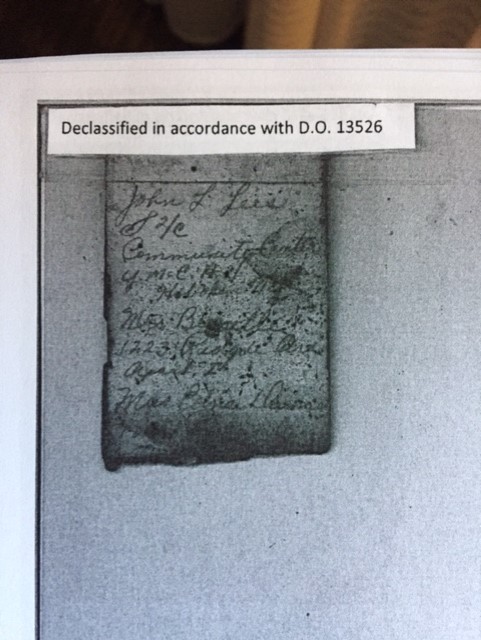
The mistake was later corrected, as Carver reportedly returned to duty on June 30, 1944, after having recovered from shrapnel wounds to his eye and leg. He also gave statements indicating that Dorel and Dougherty were exactly where they were supposed to be on that day: in the driver’s and assistant driver’s seats, respectively. He claimed he’d thrown away his extra pair of dog tags and had no idea how they were recovered. Sgt. Wilson so badly wounded he was unable to give a statement, but other evidence suggested the body buried as  Carver was indeed Dougherty, including hob nailed shoes found with his body and a charred notebook discovered in his trouser pocket, which was determined to be filled with his handwriting, noting people’s addresses and his former duty stations.

Tech. 5 John J. Dougherty's notebook, recovered from his trouser pocket following his death. 

More of Tech. 5 John J. Dougherty's notebook, recovered from his trouser pocket following his death.


One entry in Dougherty’s notebook has me intrigued, and lists the name of Dorothy Hollenshead, 220 West Madison St., Greencastle, Pennsylvania. I haven't been able to determine what connection the two had to one another. 

Photo of Dorothy Hollenshead. Ancestry.com 

When the Army finally discovered their error, they also soon realized they’d also mixed up portions of Dorel’s remains with Dougherty’s, and that mistake was later corrected, according to Army documents.

I’ve located at least two people in Missouri who I believe may have been Leo Carver’s children, but despite having sent them messages on Facebook, I have yet to receive a response. I’m hopeful that I found the right man, and one of them will call or message me with information about their father’s service. According to an obituary I found, Carver died in January 1980. But there’s always a chance that there are pictures of the tank crew, including Dorel and Dougherty, and letters he wrote home in which he may have mentioned the men he served with. The possibilities are endless, really.

After being notified of her husband’s death, Mary Dougherty in 1947 remarried Navy veteran John E. Daubaras in Philadelphia. When the Army asked her in 1948 if she would like to have Dougherty’s remains shipped home to be laid to rest - an option given to all families whose relatives were killed overseas during WWII - she passed the decision onto Dougherty’s father, who ultimately requested his son not be disturbed.


John Dougherty now rests in plot I, row 10, grave 41 at the Sicily-Rome American Cemetery in Nettuno, Italy, where he and Dorel were each interred following their deaths. My great-grandparents, however, were so grief-stricken by the loss of their son that they requested he be returned home. He rests at Greenwood Cemetery in San Diego, where he is reunited with his parents and older brother Lyle Earley, who died in late 1943 after undergoing to a skull operation he hoped would render him fit for military service.

I’ve also made efforts to locate Dougherty’s family, including a bevy of late night Facebook messages to the children of Mary Daubaras, who reportedly died in 2003. Coincidentally, while searching through the friend list of her children, I came across multiple people with the last name Dougherty. I’ve messaged each of them and am hopeful they will ultimately respond. I would be overjoyed to find a picture of Dougherty. I only have a vague description from the Army, which lists him at close to six feet tall and a slender 141 lbs. It was later determined from his remains that he likely was buck-toothed.

Please don’t forget Dorel Earley’s sacrifice for his country on this Memorial Day. But it would also be a shame to forget the sacrifice of Mr. Dougherty also, who gave everything for our country. Let us also not forget Leo Carver and Robert Wilson; while their physical wounds eventually healed, the emotional scars they ultimately bore the remainder of their days likely tormented them. 

Saturday, May 28, 2016

Dorel Lyman Earley: A Remembrance

The news Henrietta Calder Earley never wanted to receive finally arrived on a Sunday in July, 1944.

It came in the form of a cold and brutally simple Western Union telegram - which arrived at her home at 828 South Elizabeth Street in San Diego - informing her that her 21-year-old son, Dorel, was dead.

The telegram was preceded by reports in June that Dorel was missing in action in Italy.

Pvt. Dorel L. Earley 1943
Credit: Earley family
archives
While Dorel was the first in the family to die in battle, he certainly wasn’t the first Earley casualty of the war; Henrietta’s tears had scarcely hit the ground following the death of her oldest son Lyle, who died eight months before shortly after undergoing surgery to correct a skull injury. At just 26, he left behind a wife and an unborn child.

Lyle's desire to serve his country fueled a decision to undergo the risky operation and correct the childhood injury that had rendered him unfit for service.

July 16, 1944  wasn’t particularly noteworthy otherwise; early summer temperatures bathed San Diegans as they attended church or the movies. At the Consolidated Aircraft Corporation plant on Pacific Highway - where Dorel had once been employed -  workers continued to toil away for the war effort, churning out B-24 Liberators and PBYs that would eventually make their way to the skies over the European and Pacific theaters.

In Europe, the Allies battled through the hedgerows of France, more than one month after landing on the beaches of Normandy. It also had been more than 40 days since tanks of the 751st Tank Battalion - Dorel’s outfit - rolled victorious through the streets of Rome along with the 36th Infantry Division, although he wouldn’t live to see the end results of the brutal Anzio campaign that had taken the lives of about 7,000 Allied troops. In the Pacific, the war inched closer to the Japanese home islands with the mopping up of the Battle of Saipan just days earlier that resulted in the deaths of nearly 3,000 U.S. troops. Close to 10,500 men also were wounded in the battle, including future actor Lee Marvin, who served with the 24th Marine Regiment.

At the armor school in Ft. Knox, Kentucky, not far from the vaults of the U.S Gold Bullion Depository, Pvt. Glen Earley continued his training as a tank driver, the same job that had claimed the life of his older brother.

PFC Glen G. Earley, 1944
Credit: Earley family
archives
When Glen received word that his brother was missing in action, he wrote to his parents in June:

“I just couldn’t believe it and still can’t believe it’s true,” he wrote, adding that a friend had received similar news, only to discover later that his brother was in fact alive and in a hospital.

“They can get reports all wrong and all screwed up,” he continued. “I just hope and pray Dorel had a little luck and sincerely believe he had more of a chance than any of the other boys there. There are so many different things that could happen. I don’t know what I can say to make you feel better, but keep on punching and things will turn out O.K.”

Diverting attention around the possibility of tragic news he certainly must have known was likely to come, Glen instead talked about his training and a trip to the post dentist, where he had eight teeth filled.

As with nearly all of this letters home, Glen included the simple postscript: “I’ll write, you write.”

The next day, the San Diego Union ran an article with the headline: “Pvt. D.L Earley Killed in Action.”

“Pvt. Dorel L. Earley, 21, son of Mr. and Mrs. J.L. Earley, of 828 Elizabeth St. has been killed in action in the Italian theater, his parents were advised yesterday,” the article read. “Earley, a native of Logan, Utah, came here with his parents when he was a small child. He was graduated fro Roosevelt Junior High School and San Diego High School. He formerly was a carrier for The Union and Tribune-Sun and won several vacation trips and prizes for efficiency. Before his induction in the army he was employed in a local aircraft plant. Earley was killed while the Allies were entering Rome, the war department informed his parents. He had seen action in North Africa and had been in active duty on the Anzio beachhead.”

Within three months and over the protests and objections of his parents, who wrote to the War Department begging that he be excluded from combat duty as their sole surviving son, Glen would find himself in heavy fighting in Germany with the 745th Tank Battalion. On March 24, 1945, Glen was seriously wounded near the town of Uekerath, Germany, when shrapnel from an enemy mortar shell tore through his body.

Glen would recover after spending a year encased in a full body cast, but he also would suffer from the wounds he received on that March day for the remainder of his life.

“...this stuff is enough to make an young man old in a hurry.”


Like his brother Glen, Dorel Earley was careful in letters home not to say much about what he was doing, particularly anything that would possibly worry his mother.

After joining the 751st Tank Battalion in North Africa, just days before the outfit landed in Salerno, Italy, Dorel had seen his share of combat.

He got his first taste September 9, when the battalion landed on the shores of Paestum with the 36th Infantry Division as part of Operation Avalanche. While the 751st initially saw relatively light casualties, the 36th reported that about 250 men had been killed by September 10; the dead accounted for some 20 percent of the total 500 casualties sustained by the division. “The shallow grave became a regular feature at Paestum,” wrote Rick Atkinson in his novel, “The Day of Battle.”

751st Tank Battalion Shermans landing at Salerno, Sept. 9, 1943. Credit: Christopher Earley archives

The hills surrounding Salerno were the setting for several brutal sparring matches between the men of the U.S. 5th Army and the Germans, including the town of Altavilla, where tankers of the 751st went head-to-head with German armor, repulsing an attack aimed at finishing off the 143rd Infantry Regiment. In one morning alone, they knocked out eight German tanks.

The battalion also gained some notoriety with a December, 1944 article in Stars and Stripes that detailed their impressive exploits on the Italian front. “751st Tankers Have 2-1 Edge Over Hard-Hitting Nazi Armor” was the headline:

“Picture a German tank column stretched along more than six miles of road, one hundred yards in between vehicles, then erase every tank from the scene. That will give you a rough idea of what the 751st Tank Battalion, of the 5th Army, has done to the Wehrmacht. The battalion has sustained its own losses. The type of fighting in which it excels can’t be entirely one-sided; but it has knocked out, or destroyed, over two enemy tanks for each casualty of its own.”

Walt Disney-designed 751st Tank
Battalion logo. Credit: Christopher
Earley.
After several long months in combat on the Anzio beachhead, where the Germans had pinned down nearly the entire 5th Army and rained shells down upon it at will from a 280 mm railway gun dubbed “Anzio Annie,” Dorel broke his silence about the horrors of what he’d seen.

On April 23, he penned a letter to his oldest sister Donna. While the note began with the usual small-talk, his words suddenly turned serious, perhaps a reflection of the intense strain he and the other men faced.

“I know the folks must have felt pretty bad when Glen had to leave,” he wrote. “I have never told them that I have seen any action at all. I figure there is no use telling them as they would only worry all the more. I have seen quite a bit since I have been over here, and I can tell you that this stuff is enough to make a young man old in a hurry. My luck is still holding out, and I hope it continues as there is a hell of a lot of things I would still like to do before I kick the bucket.”

In a little more than one month, however, Dorel would be dead.

The breakout at Anzio would serve up some intense fighting as the 5th Army inched north towards Rome.

Assigned to the 751st’s D Company - comprised solely of  M5A1 Stuart light tanks - Dorel and his crew often were used to conduct reconnaissance ahead of the main outfit; the Stuart, with a top speed of 38 MPH on roads, also was more maneuverable than its heavy Sherman counterpart. But along with those capabilities came a certain vulnerability; the Stuart was armed with a 37mm cannon, and, at its thickest point on the gun mantlet, was protected by 51mm of armor. In contrast, the Sherman boasted a 75mm cannon and 118mm of armor at it thickest point.

M5A1 Stuart light tank. Credit: Wikimedia Commons
Dorel’s death came about during the Allied breakout at Anzio. Code-named Operation Buffalo, it began May 23 and would cost more than 2,300 lives alone  to take the town of Cisterna on May 25.

By all accounts, D Company was assigned to the 143rd Infantry Regiment of the 36th Texas Infantry - an outfit they’d served with many times in Italy - in its assault of the town of Valletri, roughly 24 miles south of Rome.

Death came to Dorel and assistant driver John Dougherty on May 28 by way of a German anti-tank round, possibly a Panzerfaust or an 88mm gun.

Whatever the method, the round penetrated the Stuart’s thin armor, killing Dorel and Dougherty instantly. Gunner Leo Carver and tank commander Robert Wilson were wounded.

Summary detailing the action that killed Dorel. Source: 751st Tank Battalion After Action Report
The scene was detailed in a memo sent from the 751st’s operation officer:
“D CO lost one tank by AT [anti-tank] fire, two killed, two wounded at 1500 hours...”

Memo from 751st Tank Battalion
S-3, detailing May 28 action at Valletri.
Credit: National Archives.
It took several days for Dorel and Dougherty’s bodies to be identified, prompting a designation of missing in action.

According to official reports by the 751st’s grave registration element, “One body, charred beyond recognition, was recovered from the driver’s seat and one body, charred beyond recognition, was recovered from the assistant driver’s seat.”

It’s unclear exactly when their bodies were recovered, but Dorel and Dougherty’s remains were wrapped in shrouds and eventually sent to the coast, where they were interred at Nettuno in what would become the Sicily-Rome American Cemetery.

Nearly 8,000 men killed during the Salerno and Anzio campaigns would come to rest there in coming months and years.

Dorel was laid to rest  in plot 2-N, row 84, grave 5471.

When graves registration men came upon one of Carver’s dog tags near the destroyed Stuart, he was erroneously declared killed in action. And while a grave was prepared and marked in his name - which really contained Dougherty’s remains - Carver was taken to Anzio’s 38th Evacuation Hospital with shrapnel wounds to his eye and leg.

Carver was later interviewed and told officers he’d destroyed his extra set of tags; how they were found nearby is a mystery.

“I had my ID tags on me when the tank was hit and still wore them when evacuated to the hospital from wounds received in this action,” Carver later wrote in a statement to 751st adjutant 1st Lt. J.W. Oliphant . “I have no idea who might have been in possession of my other tags or how they were obtained.”

He also added the following detailed description of the tank crew:

“When our tank went into the attack at 1500B on 28 May 1944 in the vicinity of Valletri, Italy, the following men were members of the crew, their jobs and positions in the tank: Pvt. Dorel L. Earley was the driver of the tank and occupied the driver’s seat; T/5 John J. Dougherty was the assistant driver and bow gunner and occupied the assistant driver’s seat to the right of the driver; Pvt. [sic] Robert D. Wilson was the tank commander and was in the upper part of the turet [sic]; Pfc. Leo Carver was the gunner and occupied the gunner’s seat in the turet [sic].”

Sgt. Robert Wilson, Dorel’s tank commander, was so seriously wounded that he was unable to give a statement.

Carver, according to official reports, would return to duty June 25. By all accounts, he also would survive the war.

751st Tank Battalion casualty report. Source: 751st Tank Battalion
After Action Report.
When officials learned of their error regarding Carver, it prompted an investigation that would not only determine that the remains marked at Nettuno as his in fact belonged to Dougherty, but also that portions of Dorel’s and Dougherty’s  remains also were misidentified.

Hob-nailed shoes and a notebook bearing Dougherty’s handwriting finally confirmed that the Army had made a mistake. Interviews with other D Company men also described Dougherty - who hailed from Pennsylvania - as having had long and protruding “buck” front teeth, a detail that matched the remains in Carver’s grave.

The mistakes, while ghastly, were promptly corrected; corresponding remains were exhumed, reunited, and finally re-interred.

In a letter penned with pleading words, Henrietta Earley on Oct. 18, 1945 wrote to the army’s adjutant general, asking for more information about the action that killed her son:

“As yet we had never received any information from his commanding officer, Chaplain or anyone in his Bn and so very little information  of any kind of his combat overseas or his death. I would like to ask if it is possible to have a copy of his service record? Or any information of his last Bn Co D, 751-Tank Bn APO 464, before that he was with the 34th recon troop, APO 34.

“Our younger son, Glen, who was wounded in Germany in May [sic], and who is still a bed patient has received a book, the record of his Tank Bn 745th which was written in honor of the boys of that Bn who lost their lives; it is wonderful, maps and all, which are a joy to him. We have hoped so much that we may receive one of his brothers Tank Bn. Can you tell us if one of this 751th [sic] has been made up and if so how we may obtain a copy? As yet we have not received any personal effects of Dorel’s, or his bonds, which he had paid for before going overseas. We received the one for Mar 1943 when he went overseas in July 1943 canceling the bonds then, so there should be either three or four still due him.

“I do realize these things take time,” Henrietta continued. “But it is now a year and five months, and we are very desirous to obtain any information or settlement of these things, if possible.

“Has any provisions yet been made to have the bodys [sic] of our boys returned home?”

Henrietta and Glen Earley, 1940's
Credit: Earley family archives
Henrietta would not receive a reply until June, 1946, when the quartermaster sent a letter with very basic information:

“He (Dorel) left the United States for foreign service on 25 August 1943 and served in North Africa and Italy. He was killed in action on 28 May 1944 at Valletri, Italy as the result of burns received in his tank, while participating in the campaign of Rome-Arno. At the time of his death he was serving as a private, Company D, 751st Tank Battalion. His character and efficiency rating as a soldier was recorded as excellent.

“With reference to your statement that you received no word from the Commanding Officer of your son’s organization, this procedure of reporting casualties was not in effect at the time of his death. Failure to receive a communication from other members of his battalion was possibly due to the existing military conditions which sometimes make it impossible for military personnel to write to the families of deceased soldiers.”

Dorel would remain at Nettuno until the War Department approved the return of servicemen killed overseas to cemeteries in the United States. While every family was given the option of having their loved ones returned or to have them remain in the government-maintained cemeteries where they had lain since the war, roughly 70 percent chose repatriation.

Henrietta and John Earley were among them.

In a letter from the quartermaster general dated June 25, 1946, details of that option were sent to the Earleys:

“The War Department has now been authorized to remove, at Government expense, to the final resting place designated by the next of kin, the remains of those American citizens who died while serving overseas with our armed forces during the war,” it read.

But even in the years following the war, shortages of many items continued to be an issue, even when it came to burying the dead:

“As you probably know, the supply of steel for the manufacture of caskets, is at present uncertain,” the letter continued. “Without this essential item, the movement of remains cannot properly be initiated."

The letter also addressed concerns raised by John Earley in a Jan. 11, 1946 correspondence in which he reminded the army that his son’s personal effects had not been returned; since Dorel’s death, the quartermaster’s office continued to claim no such effects had been found.

“We have written to you several times regarding the personal effects of our son, who was killed in the African War Theater May 28-1944,” John wrote. “Up to the present time we have failed to receive any reply. We feel that we have been very patient but would like to at least receive a reply to our request. We think that there must have been some of his personal belongings and they would certainly mean nothing to anybody but his family. There was also several packages that we know he couldn’t have received that should be returned but up to now nothing has been returned. Could we at least hear from you and let us know if anything is being done about this?”

Dorel Earley (left) and Glen Earley. Credit: Donna DeYoung
In a letter dated April 1, 1947, Brig. General G.A. Horkan, Chief of the Army’s Memorial Division, sent the following letter to Henrietta and John Earley:

“Inclosed herewith is a picture of the United States Military Cemetery Nettuno, Italy, in which your son, the late Private Dorel L. Earley, is buried.

“It is my sincere hope that you may gain some solace from this view of the surroundings in which your loved one rests. As you can see, this is a place of simple dignity, neat and well cared for. Here, assured of continuous care, now rest the remains of a few of those heroic dead who fell together in the service of their country.

“This cemetery will be maintained as a temporary resting place until, in accordance with the wishes of the next of kin, all remains are either placed in permanent American cemeteries overseas or returned to the Homeland for final burial.”

Sicily-Rome American Cemetery, where John J. Dougherty
is buried today.
Credit: Wikimedia Commons
In May, 1948, Dorel began his long journey home to San Diego and was officially disinterred from Nettuno May 20.

In Naples, his remains were loaded aboard the USAT Carroll Victory, which would arrive in New York in July. From there, he made the trip across the U.S. aboard a train toward San Diego, via Oakland.

Henrietta and John Earley could finally breathe at least a small sigh of relief on Aug. 13, 1948, when Dorel returned home.

 At 3:30 p.m., along with a military escort, Dorel’s flag-draped casket was unloaded from the train and eventually taken to Greenwood Cemetery’s mausoleum, where he would be united with his brother Lyle.

Credit: Earley family archives.
In its silent stone corridors, John and Henrietta also would reunite with their sons lost during the war years, John in 1979 and Henrietta in 1986.